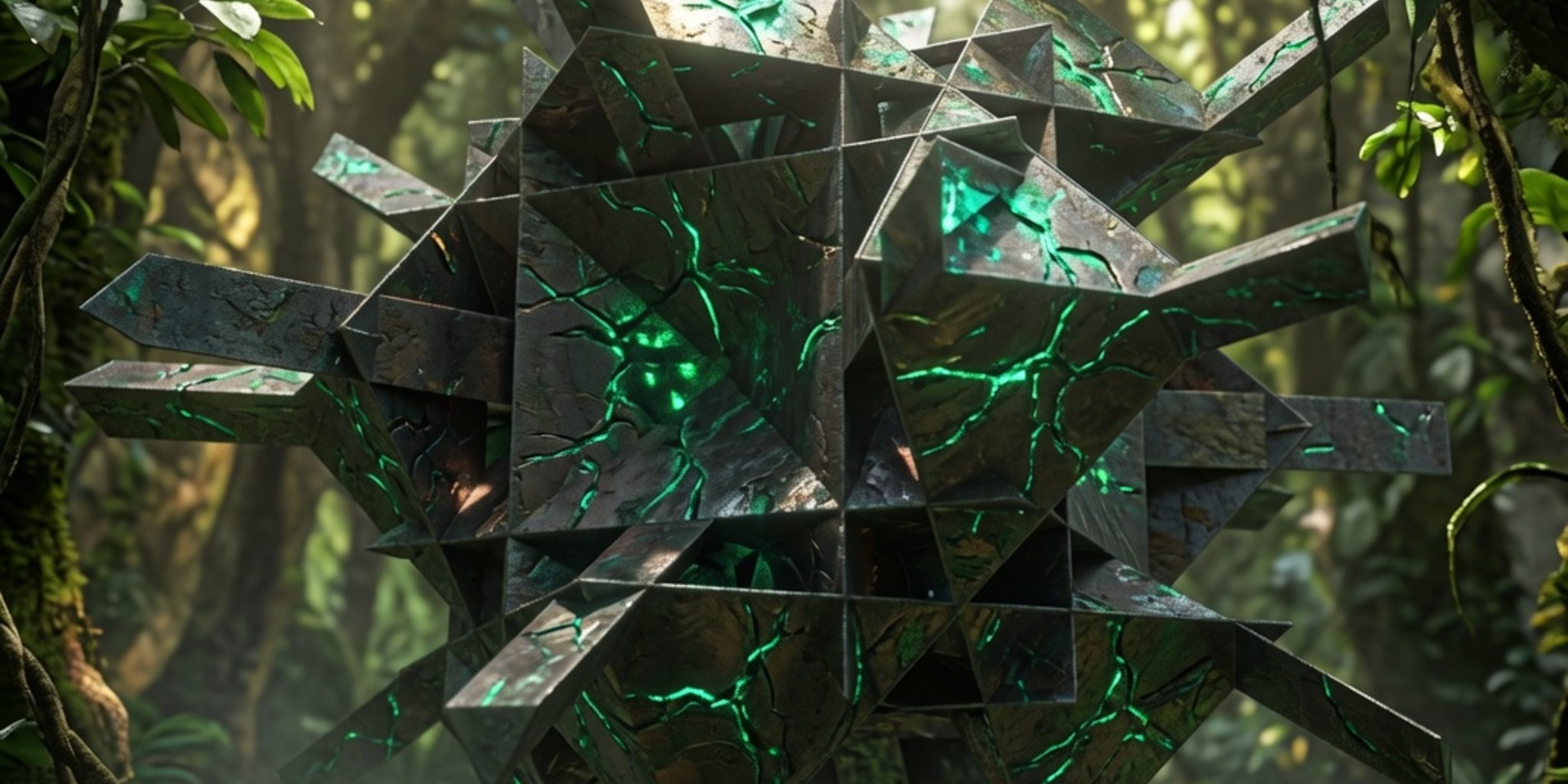
Clifford Sage’s role in [RES] Lutetium (2017) is a specific, documented example of manual 2D-to-3D reverse engineering...
That is now cited as a historical precedent for what modern AI image-to-3D tools can accelerate.


{ Penetration Test 08/06/2026 }
Clifford Sage’s role in ENERGY PANGEA's Rare Earth Sculptures: Lutetium (2017) is a specific, documented example of manual 2D-to-3D reverse engineering that is now now cited as a historical precedent for what modern AI image-to-3D tools can accelerate.
Who is Clifford Sage?
Clifford Sage (also known as Recsund) is a London-based CGI artist, technical artist, 3D modeler, animator, Unreal Engine developer, XR/VR specialist, and musician. He graduated from the Royal College of Art in Visual Communications (2010) and works across experimental art, live A/V, game-adjacent projects, and collaborations with other artists (including Iain Ball, Joey Holder, etc.). His practice involves world-building, environmental design, animation, and technical 3D work for clients and festivals (e.g., Rewire). He maintains cliffordsage.com and has been active in scenes like Quantum Natives.
The Specific Project: Lutetium Reverse Engineering (2016–2017)
This occurred within Iain Ball’s long-running ENERGY PANGEA (2010–2019) system, specifically the Rare Earth Sculptures series. The element Lutetium served as one node in a larger “object-oriented think tank” exploring rare earth elements, resource extraction, techno-dependence, conspiracies, altered states, and transmedia propagation.
The pipeline was explicitly framed as “reverse engineering” and the first major demonstration of Ball’s concept of Interface Penetration:
Source (2D): Hyperdimensional polytope designs (complex 4D+ geometric forms) were rendered/projected into 2D visualizations by Jonathan Bowers (Hedrondude) of polytope.net. These are mathematically precise but inherently lossy projections — higher-dimensional symmetry flattened into 2D images with overlaps, ambiguities, and missing depth information.
Sage’s Manual Reverse Engineering (2D → 3D): Clifford Sage received these limited 2D renders and manually reconstructed them into coherent, fabrication-ready 3D models. This required:
Deep geometric intuition about uniform polytopes and their projections.
Interpretation to “solve” for the missing dimensional information.
Creation of clean meshes suitable for 3D printing (not just visual approximation).
Ball’s own documentation describes this as Sage modeling “the objects in 3D based on the limited 2D information.”
Physical Fabrication & Mutation: Energy Pangea then:
3D printed the models in solid nylon plastic.
Colored/painted them.
Renamed the resulting sculptures (examples: HYPER ACCUMULATOR, INGRESS-REPORT, INERTIA-REALM, INTERNET WORMZ, INTROVERZION-CELL).
Placed them in various physical environments.
Documented, photographed, and circulated them digitally.
The physical nylon prints are described as solid, modular “symbiotes” — sharp-edged, geometric forms derived from the polytopes, sometimes with organic or viscous qualities in Ball’s broader aesthetic.
Why This Counts as “Reverse Engineering”
Higher-dimensional polytopes cannot be directly experienced or modeled in our 3D space without projection. Reconstructing a usable 3D form from 2D projections is a classic inverse problem — similar to photogrammetry or archaeological reconstruction from partial data. Sage performed this manually in 3D software around 2016–2017, long before accessible consumer AI tools for image-to-3D, Gaussian splatting, or neural radiance fields existed.
On Ball’s Manifold/Paragraph pages for the related NFT (INTROVERZION-CELL: [Rare Earth Sculptures] Lutetium, 2017), this step is explicitly called out as the first “penetration” in the transmedia chain:
2D diagram (Bowers) → 3D model (Sage) = interface penetration #1
Digital 3D → physical print = penetration #2
Physical object in the world → photographic documentation/circulation = ongoing propagation penetration #3
Photographic documentation and digital recontextualisation → blockchain and Arweave provenance #4
The “sculpture” is not any single plastic object but the propagating system itself — a virus-like entity that binds to and mutates across substrates.
Connection to SETHIX-QR Labs: Emergent Propagation
In "SETHIX-QR Labs: from Interface Penetration to Emergent Propagation", Ball writes:
“An AI generated image of the original sculpture (.glb file) becomes more tangible than the source file itself. Large scale fabrication can be realised via the AI rendered .jpg with no need for the .glb to be involved… (as Clifford Sage did manually with Lutetium in 2017…)”
Sage’s skilled manual labor is now positioned as the artisanal precursor to automated AI reverse-engineering pipelines. What once required a specialist CGI collaborator can increasingly be done (or at least bootstrapped) by AI, enabling faster mutation, iteration, and physical output from 2D sources. This accelerates the very “interface penetration” and “emergent propagation” Ball is theorising in the new SETHIX-QR work.
Additional Context
Hedrondude / polytope.net: Bowers’ site is a rigorous mathematical resource with visualizations of uniform polychora (4D), polytera (5D), etc. The 2D images Sage worked from are not casual drawings but precise projections of mathematically defined higher-dimensional objects — often intricate, symmetrical, and visually complex.
Sage’s dedicated page on his site (cliffordsage.com/iain-ball.html) references the collaboration as “Modeled Sacred Geometries for 3D print” (polytopes frequently carry mystical/sacred geometry associations in these artistic contexts).
The resulting physical works have appeared in exhibitions (e.g., Alyssa Davis Gallery, Future Gallery) and are now archived/on-chained as NFTs as part of ENERGY PANGEA’s legacy system.
In short, Clifford Sage provided the critical human technical bridge that turned abstract 2D mathematical visualizations into tangible 3D-printed sculptural nodes. His work in 2017 is a concrete historical example of the exact translation process Ball is now scaling with AI and blockchain infrastructure in Emergent Propagation.
An yet, there always exists the inevitability of morphing, decoherence, and machine capture, where the object changes as it penetrates through different interfaces...

Even though Ball can now say “we no longer need the original 2017 Sage 3D files,” the form is never transmitted cleanly. Every interface penetration introduces:
Morphing (geometric drift, simplification, or elaboration by the tool)
Decoherence (loss of higher-dimensional symmetry or precise relational structure)
Machine capture (the biases, training data priors, and resolution limits of whatever AI image-to-3D model is used — Meshy’s aesthetic preferences, TripoSR’s topology tendencies, etc.)
The output is always a mutant, not a clone.
Why Bowers’ mathematical models matter so much as the origin point
This is where the specificity of the starting substrate becomes decisive.
Jonathan Bowers’ polytopes (on polytope.net) are not generic “complex shapes.” They are:
Rigorously defined uniform polytopes in 4D and higher
Possessing extremely high degrees of symmetry and combinatorial regularity
Mathematically “pure” in a way that most hand-sculpted or noise-based geometry is not
When you begin the propagation chain with that kind of object, the mutations that occur downstream tend to remain structurally interesting rather than collapsing into generic organic blobs or noise. The mathematical DNA acts as a kind of attractor or invariant that survives (in distorted form) across translations:
Sage’s manual reconstruction already had to interpret and “solve” the lossy 2D projections — that was the first major morph.
The 3D-printed nylon versions introduced material and fabrication constraints.
Photographic documentation added lighting, context, and framing.
New renderings (and any future AI image-to-3D pass on it) add cinematic atmosphere, material simulation (the glowing green cracks and glossy surfaces of the featured renders), environmental embedding, and whatever inductive biases the model has.
Each step decoheres the original mathematical precision, but because the seed was so highly structured and symmetrical, the resulting mutants often retain a recognizable “hyperdimensional” or “sacred geometric” character even as they mutate. That’s probably not accidental.
If Ball had started the entire ENERGY PANGEA / Lutetium project with arbitrary or purely organic forms, the propagation would likely produce very different (probably less coherent or less compelling) results after a few generations of AI mutation. The Bowers origin gives the system a high-signal, high-symmetry seed that can withstand — and even benefit from — successive layers of interface capture and morphing.
So yes: bypassing Sage’s specific 2017 files is now technically possible, but you’re never bypassing the consequences of having begun with Bowers’ mathematical polytopes in the first place. The form changes, but it changes from a very particular kind of origin.
This is part of what makes the work feel less like traditional sculpture and more like a controlled evolutionary or viral process.
This “Penetration Test 08/06/2026” is the latest mutant in that lineage. If someone (or Ball) now runs it through current image-to-3D tools, we’ll get the next generation of decoherence/machine capture — and that new mutant will itself become available for further penetration.